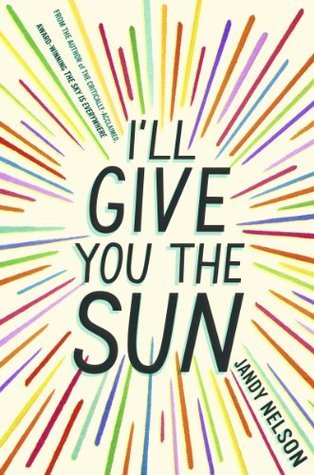
I'd heard a lot of hype about Jandy Nelson's newest book,
I'll Give you the Sun, before I picked up a copy, so while I was looking forward to reading it, I was also a little hesitant. I've read too many books that didn't live up to the hype.
But Nelson's book does: it's vivid, powerful, beautifully written.
The story is told from the point of view of two twins, on two different timelines: Noah, at 13, and Jude, three years later. When the story starts in Noah's timeline, Noah is fretting about his increasing distance from Jude, obsessing about getting into the nearby arts academy, and falling in love with the boy next door.
Three years later, when Jude picks up the story, everything has changed. It's Jude, not Noah, who's at the fancy art school. Gone is the pretty, popular girl of the early narrative: Jude hides herself in baggy clothes, stuffs her hair under a hat, and does her best to be invisible. Noah is equally unrecognizable: he no longer creates art, he runs track, and the boy who fiercely resisted any kind of homogeneous impulse now blends in with the crowd. It's clear something has unmade their family, and that mystery is part of what drives the heart of the story.
But what I fell in love with here were the characters, not the plotline. Nelson has the twins so vividly realized that they jump off the page: Noah with his tendency to think of his own life in terms of artistic portraits, his sensitivity to color and emotional resonance. Jude and her adorable collection of superstitions and tendency to talk to her grandmother's ghost. While I didn't love everything the twins did (they both screwed up some pretty major things), I did love them, and it's to Nelson's credit that while the end wraps up fairly neatly, it doesn't feel too simplistic or clichéd--in fact, I was particularly impressed with the emotional wallop of the ending. I don't cry at a lot of books, but this one did it for me.
That said, there's a fair amount of language, sex (some action but lots of talking/thinking about it) and drug use, so it's definitely for more mature teen readers.
Some favorite lines:
"Love does as it undoes. It goes after, with equal tenacity: joy and heartbreak."
"Because who knows? Who knows anything? Who knows who's pulling the strings? Or what is? Or how? Who knows if destiny is just how you tell yourself the story of your life? Another son might not have heard his mother's last words as a prophecy but drug-induced gibberish, forgotten soon after. Another girl might not have told herself a love story about a drawing her brother made. Who knows if Grandma really thought the first daffodils of spring were lucky or if she just wanted to go on walks with me through the woods? Who knows if she even believed in her bible at all or if she just preferred a world where hope and creativity and faith trump reason? Who knows if there are ghosts (sorry, Grandma) or just the living, breathing memories of your loved ones inside you, speaking to you, trying to get your attention by any means necessary? Who knows where the hell Ralph is? (Sorry, Oscar). No one knows.
"So we grapple with the mysteries, each in our own way."
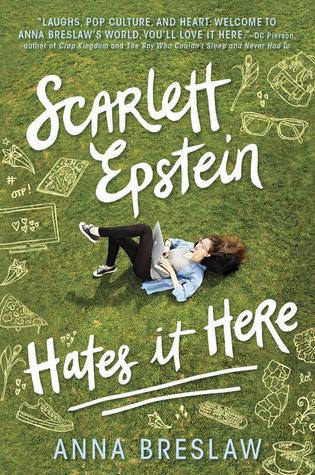 From the moment you start Anna Breslaw's witty, heart-felt SCARLETT EPSTEIN HATES IT HERE, it's pretty clear that Scarlett is not your ordinary teen--and Breslaw isn't your ordinary writer.
