Showing posts with label dystopian. Show all posts

Wednesday, February 18, 2015

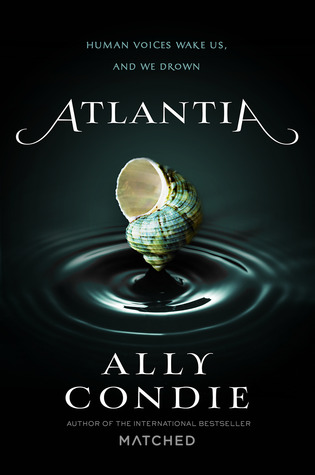
Atlantia

I really enjoyed Ally Condie's latest, Atlantia, which has a quiet, restrained beauty to it. The language is spare but lovely, and the plot is quiet but moving. Readers who come to this expecting something fast paced--or about mermaids--are likely to be disappointed, but I thought it was well done.

AtlantiaRio Conwys is a twin, and she has spent her whole life in Below knowing two things: one, that when it's her turn to choose Above or Below, she will choose the world above, and two, that she has to always conceal her siren voice. In Atlantia, the world Below is a carefully engineered underwater city to house humans who fled from the terrible pollution above. But some have remained above, to grow the crops that sustain those below. And each year, those who reach 17 can choose whether to stay Below or go Above--but only one can go from each family. So when Rio's sister Bay chooses to go above, trapping her below to deal with Bay's loss while still grieving the recent death or their mother, Rio doesn't know what to think or do.

Much of the early part of the novel is spent with Rio trying to find her new place in the city and to find a way to reach Bay in the world Above. She tries racing for money, and meets True, a warm-hearted boy who constructs clever machines to attract more viewers (and money) in her races. At the same time, Rio tries to avoid her aunt, a siren who may or may not have been responsible for her mother's death. But the more Rio  learns about the politics of Above and Below, the more she begins to question what she's always known, and what her true role is.

I think what I liked most about this book is that, in it's heart, it's not about the romance, but about the relationship between sisters: between Rio and Bay and between her aunt and her mother. And I liked that the slower pace allowed it to be more character driven--the readers see Rio coming into her true voice in more ways than one. There were some things about the world-building I would have liked to understand better, but ultimately, I thought it was lovely.

Tuesday, February 17, 2015

Ruins

Ruins (Partials Sequence, #3) I'm not a huge fan of dystopian novels, but Dan Wells' Partials series is pretty amazing. He's built a detailed, fascinating world that's complicated and interesting and rich all at once. In the wake of a world-war where humans created Partial soldiers, the world was nearly destroyed when those same Partials (built with modified human DNA and with a unique ability to link to one another emotionally) attacked the humans who made them. Now, the humans are vastly out numbered and unable to reproduce--every human baby dies within days of birth. And the Partials too are expiring--literally. Something built into their genetic code means that each Partial dies when they hit twenty.

Kira, who is as far as I can tell the heroine of these stories, is a Partial who was raised as a human, and she's spent her whole life trying to figure out what is killing human babies. She's also fallen in love with a partial, Samm, and she wants nothing more to figure out a cure for the expiration as well (something she doesn't seem to have). She thinks she may have found the solution--but that will require the humans and Partials *not* killing each other, a task that seems increasingly difficult as a small band of human rebels is carting a nuclear bomb north to detonate in human headquarters, and the Partials are growing even more distrustful of humans as a new virus (one humans appear immune to) begins attacking them. 

Wells does a nice job pulling the plot forward even as the characters have to wrestle with complicated questions, like, what makes people (humans and partials alike) human? And what kinds of casualties are acceptable when looking to preserve an entire species.

There were a few slow parts, when various groups were on the run (though I generally didn't mind them as it was an opportunity to explore more of this post apocalyptic world). There were also a lot of characters--sometimes it was hard for me to keep everyone straight in my head. There as also a secondary plot thread involving the creepy Blood Man that I found incredibly disturbing (and unnecessary?), but it's very in keeping with the style of Mr. Wells' earlier books. But for the most part I found it a satisfying ending to the trilogy--one that managed to offer hope without resolving things too neatly.

Wednesday, January 7, 2015

Queen of the Tearling

The Queen of the Tearling (The Queen of the Tearling, #1) Erika Johansen's The Queen of the Tearling came highly recommended by someone whose judgment I trust, so I was looking forward to reading it. And while I'm still sorting through my response, I think I liked it more than I loved it.

Kelsea Raleigh has been raised her entire life in a secluded backwoods, preparing for her eventual ascent to the throne. As both her uncle, the Regent, and the neighboring queen of Mortmesne want her dead, she's kept in hiding until she's old enough to assume the throne herself. But first, she has to survive a)getting to the castle and b) her coronation. And though she's surrounded by her queen's guard, both of these objectives are in question for much of the story. Then, if she survives, she faces the monumental task of rebuilding a broke kingdom, all while under the threat of a Mort invasion.

I thought the premise was interesting--though Kelsea's world reads more like high fantasy, it's actually apocalyptic, set several hundred years in the future after The Crossing (I'm still not entirely sure what that was), in New Europe, a world that has largely lost the technology and medical advances of our present time. I would have loved to see more about the premise explained in the book, since I'm still fuzzy on what the Crossing was, and where New Europe is in reference to today's world.

And while it took me a while to like Kelsea (initially, she didn't seem to have much personality), I found I appreciated her quiet confidence, even her insecurities. It's no easy thing to assume a throne that you've been woefully ill-prepared for. Kelsea has lots of book knowledge, but little knowledge of people and no experience with corruption. She reminded me quite a bit of Elysa, in Rae Carson's Girl of Fire and Thorn series (down to the  mystic blue gem that is her heritage).

The pacing of the first part of the book was slow, but I stayed up way too late finishing the last 1/3 or so of the book.

I don't think the book is perfect--there are some logical inconsistencies that other reviewers have pointed out, and I kept being distracted by some of the extraordinary ways blood behaved--but I think it's a good story, full of interesting and complex stakes. I'd like to see where Johansen takes this in the sequel.

Note: I've seen this book categorized as YA, but though Kelsea is 19 in the book, I would only give this to the most mature YA readers--there's a fair amount of language and violence in the book.

Tuesday, July 29, 2014

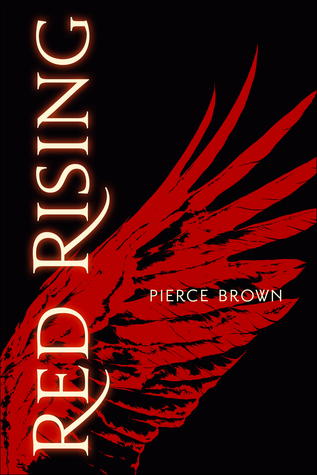
Red Rising

Red Rising (Red Rising Trilogy, #1) Lots of books have been compared to The Hunger Games--by publicists, by wanna-be-writers, publishers, and more.

Most of them don't live up to the hype.

This one, with a cover blurb bravely comparing the hero to Ender Wiggins and Katniss, actually does.

It's a frenetic, wild, violent read. I thought about it when I wasn't reading, and when I was reading, I stopped only reluctantly.

In a futuristic society, where one's future is determined by one's caste, Darrow is a red, the lowest of the low. His people mine underneath the surface of Mars, searching for a mineral that will help terraform the planet and make it habitable--they are told--for the other color castes seeking refuge from earth.

At sixteen, Darrow is already married and a man--a helldiver for his Lykos clan. He dreams of revolution, as his father did, but mostly he just works and lives as hard as he can. Reds don't tend to live long.

But when the unthinkable happens and Darrow loses nearly everything he cares for, his dreams change. He's given a mission by a secret society: infiltrate the Golds, the highest of the castes. With some surgical assistance, Darrow is transformed: his face, his body, his eyes, even his brain.

Darrow manages to make it into the Institute, where the ruling Golds are made Peerless (scarred warriors who are strong, ruthless, and committed to maintaining their power). And there, everything starts changing.

For starters, there's the passage--a bizarre, horrible Darwinian rite of passage. (This book is not for the faint-hearted. Or the very young. While it's rated YA for the protagonist's age, it's definitely violent).

Then there's the Institute's war games, where Darrow and forty-nine others are drafted into house Mars and have to compete against 11 other houses (all based on Roman gods). The resulting rivalries are no-holds barred fighting, meant to teach the students how to fight, how to cheat, how to survive--and how to become leaders.

Darrow fails. A lot. He makes stupid mistakes. A lot. But, impressively, he grows.

So often novels like this are focused on the plot and world-building--but Darrow, despite his impressive intelligence and physical skills, is not perfect. His character arc in the novel was painful, heart-wrenching, but felt believable.

Of course, not everything in the novel was believable. (For one, why is it that none of the Gold children knew what the Passage was? Presumably, the leaders have made it through. Also presumably, they would have told their children what to expect--or at least made sure they could survive it.)

But the plot and characters kept surprising me, and I raced through the book.

By the end, I'll admit, I was a little tired of the violence. But I think that's part of the point: the cost of maintaining a hugely unequal class society. And the cost of absolute power.

Definitely worth-reading--particularly for fans of The Hunger Games, Ender's Game, John Scalzi's Old Man's War and other sci-fi/dystopian rebellions.

Tuesday, July 22, 2014

The One

The One (The Selection, #3) When I first picked up the Selection a couple of years ago, I was intrigued. I'm tired of grim dystopians--The Selection, with its premise of the Bachelor meets the Hunger Games (minus the violence) in a futuristic America, sounded like fun. And in a lot of ways, the series has been. There have been pretty dresses, swoony kisses, girl fights (and friendships) set against a vaguely revolutionary backdrop.

But it's also been like riding an emotional rollercoaster. In The Selection, America is one of thirty-five finalists. She's there only reluctantly, because her heart was given to Aspen, but her family convinces her to take a chance at becoming queen. Then, of course, she starts to fall for Maxon, the prince charming. And Aspen shows up as a guard at the palace, further complicating matters. The on-again-off-again that resulted from American trying to decide between Aspen and Maxon in book two (The Elite) drove me nuts.

Here, America has made it to the final four. The pressure of northern and southern rebels on the monarchy is heating up, and America and Maxon are struggling as much as ever to understand each other, despite their evident attraction.

I don't know. I'm clearly not the target audience for this book, and maybe I'm too old and too cynical. But I got tired of Maxon and America's misunderstandings (why couldn't she just tell him how she felt? Why did she lie to him about Aspen for so long?). And the revolutionary threats didn't feel very real to me--I would have loved to see more development of the political side of things.

I will give Cass credit, though, for moving past the typical girl rivalry in this novel and trying to show how friendships develop in the most unusual of places. But I ultimately wasn't convinced by how easily things were resolved for the characters.